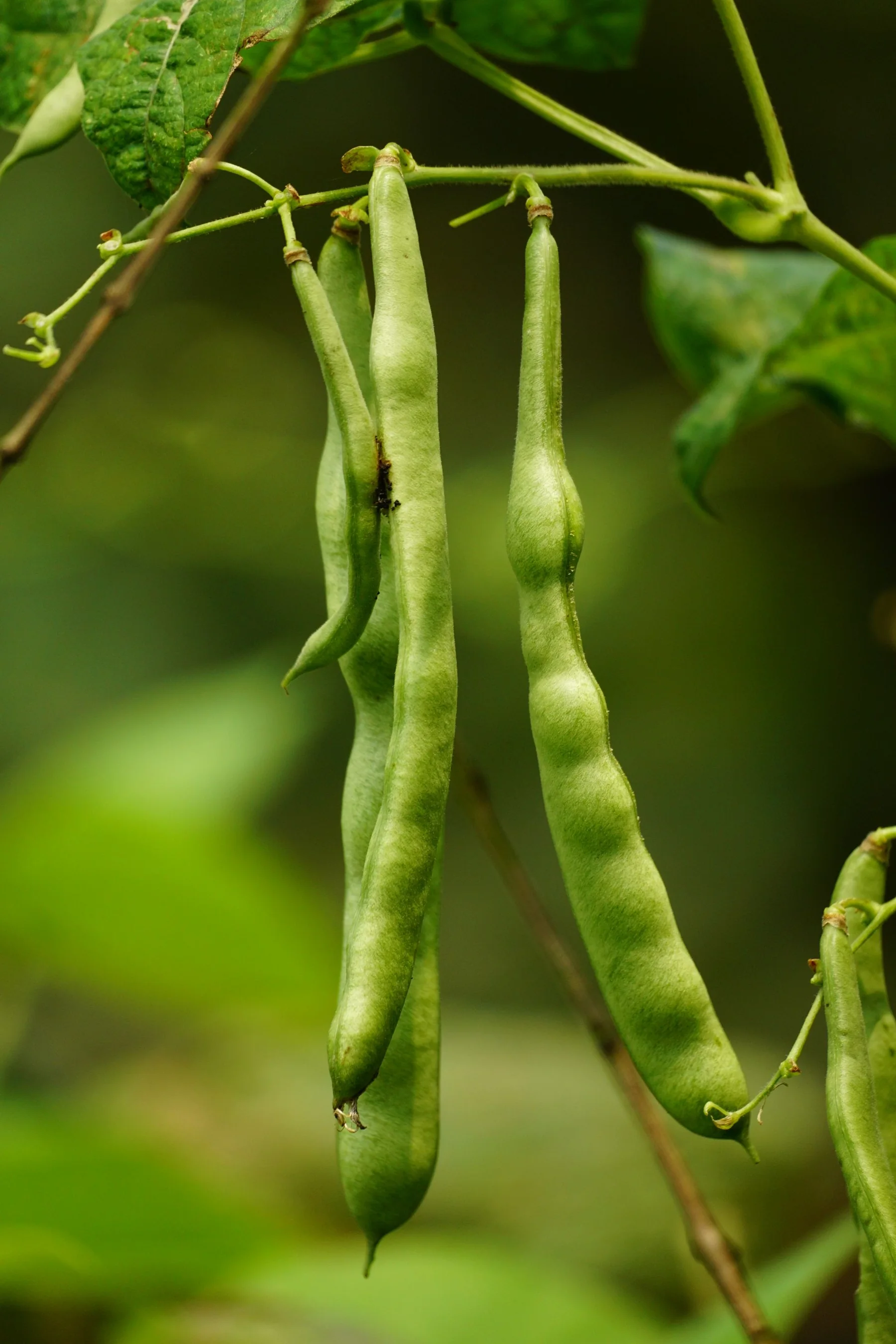
Peas and beans are often recommended as starter crops for seed saving because their flowers usually pollinate themselves. That makes them easier to manage than squash or corn, but “self-pollinating” does not mean “impossible to cross.” Bees can move pollen, varieties differ, and isolation advice depends on the species and the level of varietal purity a grower needs. A small garden can still save useful seed if it names the goal and records the limits.
Identify the crop and the seed goal
Write down the exact species and variety before discussing distance. A snap pea, dry bean, runner bean, and lima bean do not necessarily share the same pollination behavior. Common names can hide botanical differences, and the same common name may refer to several species. Check the seed packet or supplier page for the botanical name, whether the variety is open-pollinated or hybrid, and any isolation recommendation.
If the goal is a home planting that resembles one favorite crop, a modest chance of crossing may be acceptable. If the seed will be distributed as a stable named variety, the standard must be higher. Seeds saved from an F1 hybrid often segregate in the next generation even when no outside pollen enters. Isolation protects against pollen from another compatible variety; it does not turn a hybrid into a stable open-pollinated line.
Start with one variety of the same species. This is the simplest way to lower cross-pollination risk in a balcony or community plot. Keep other related varieties in the garden only if you can separate their flowering periods or protect selected flowers. Flower timing can overlap across beds and even across neighbors’ yards, so a distance measured only within your property may miss a nearby pollen source.
Select enough plants to represent the variety
Do not choose a single attractive pod and assume it represents a population. Select several healthy, true-to-type plants, and avoid individuals with unexplained disease, severe stress, or traits contrary to your goal. For beans, let pods dry fully on the plant before harvest when weather allows. For peas, allow pods to mature beyond the eating stage until they become dry and firm. If autumn rain threatens, finish drying indoors in a labeled, ventilated place.
Population size matters for preserving diversity. A small balcony may not support the population recommended for maintaining a variety’s genetic breadth. That does not make a household seed lot worthless; it means the lot is a limited selection, not a conservation population. Record the number of parent plants and whether seed came from one or several. For long-term variety preservation, coordinate with a seed organization that can maintain a larger population.
Keep seed from different plants in separate envelopes until the harvest is dry and inspected. If the crop is healthy and true-to-type, you may bulk seed from multiple plants intentionally. A separate envelope per parent can preserve information if an off-type appears the next year. Labeling is a form of isolation after harvest: a mixed jar cannot be separated by looking at the seed.
Choose a realistic isolation method
- One variety: grow only one compatible variety of the species in the garden and ask about nearby plots when purity matters.
- Distance: follow a crop-specific Extension guide; do not apply a single generic number to peas and every bean species.
- Time: stagger flowering only when local weather and crop maturity make non-overlap likely, then confirm dates in the garden.
- Bag flowers: protect selected buds before opening and hand-pollinate where the species and scale allow; label the protected flowers.
- Accept uncertainty: for a casual home lot, record nearby varieties and share the seed as “home-saved; crossing risk unknown” when appropriate.
Isolation distances in Extension tables are tied to particular crops, varieties, climates, and purity goals. A distance published for commercial seed production should not be presented as a guaranteed rule for a windy, pollinator-rich courtyard. If you cannot meet the recommended spacing, use another method or tell future growers what you could not control.
Keep the crop healthy through maturity
Seed plants stay in the garden longer than food crops, so they experience more weather and disease pressure. Give them adequate airflow, avoid overhead irrigation when foliage disease is a concern, and remove severely diseased plants under local guidance. Do not save seed from a plant that showed a serious transmissible disease simply because the pods look dry. Some pathogens can travel with seed, and ordinary storage does not make a lot safe.
Dry pods after harvest until they crack cleanly and the seed feels hard. Shell them over a clean surface, remove shriveled or damaged seed, and keep each variety separate. Let seed finish drying in a shaded, airy place before sealing it in an airtight container. Record harvest date, parent count, isolation method, and any neighboring varieties. The note that says “one variety on the block” may be more useful than a confident but undocumented purity claim.
Check what grew next season
Plant a small sample and compare the plants with the parent description. Look for differences in flower color, pod shape, maturity, and growth habit, while remembering that weather and soil can alter appearance. If a clear off-type appears, remove it from the seed lot and preserve the observation. A single generation cannot establish a variety’s full history, but it can reveal a likely cross or a mislabeled packet.
Adapt separation to the crop and seed goal
This guide is for home-scale planning and does not establish seed certification or varietal purity. Isolation distances, pollinator movement, and population-size guidance are crop-specific. Consult Penn State and University of Georgia Extension material for the named species and use a regional seed-production guide when distributing seed. Keep uncertainty visible on every packet.
Sources and further reading
- Seed Saving Basics — Penn State Extension
Self-pollinated beginner crops and remaining cross-pollination risk.
- Seed Saving — University of Georgia Extension
Crop-specific seed-saving and isolation considerations for home gardens.